

Focusing on “Researchers’ Big Picture,” this series explores the future societies they envision through their research. How does their research intersect with our lives? Their visions might provide valuable insight into the path ahead for all of us.
“My goal is to create a society where diverse people can understand each other through technology,” says Mr. Chujo. We spoke with him to find out what he means by that and to learn about his research in Value Exchange Engineering.
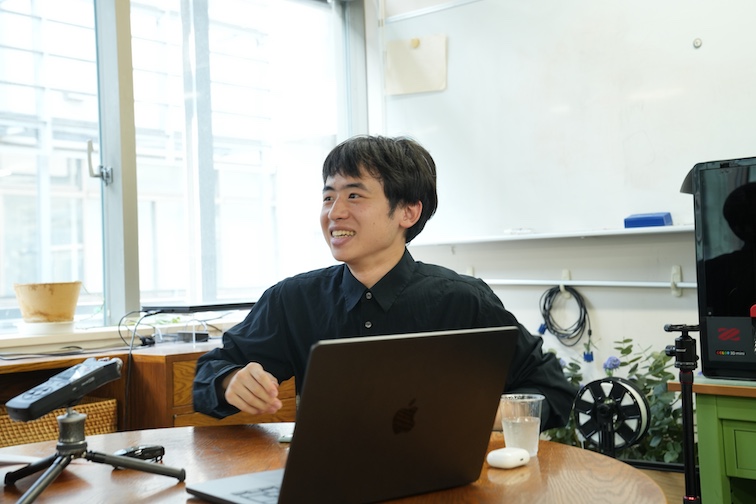
Interviewing:
・Name: Rintaro Chujo
・Affiliation: Ph.D. Student, Interfaculty Initiative in Information Studies, The University of Tokyo
Pursuing the Relationship Between Humans and Technology Reveals Future Challenges
_____________________________
▶︎What kind of research are you conducting in Value Exchange Engineering?
Simply put, it’s a field called ‘Human-Computer Interaction,’ or HCI for short. It explores the relationship between humans and computers, and how humans change through these interactions.
It’s a collaborative field where researchers from various disciplines—such as computer science, psychology, and anthropology—work together. In fact, the computer mouse or touch panels on smartphones that you are all familiar with were actually invented through HCI research.
▶︎So, is it research on communication between humans and computers?
It involves not only the dialogue between humans and computers but also human-to-human communication mediated by computers.
For instance, the advent of video conferencing systems has enabled remote work. Social networking services (SNS) have made it easy to connect with people you’ve never interacted with before. New technologies transform how we relate to others and, by extension, the very way we live our lives. My research explores the possibilities of such changes.
Recently, I’ve been describing my work to others as being an ‘ethnographer of possible futures.’
The literal translation of ethnographer is ‘participant observer.’ This refers to a person who simulates how society might or should be when a certain technology exists in the future, creates a prototype, and provides a platform for experiencing it. At that time, he/she observe and records how people think and what actions they take.
▶︎So, is an ethnographer kind of like Doc in Back to the Future?
Haha, it might be. If we can predict the future that might be created by new technology and simulate that future, we can imagine ‘visiting’ that world in our imagination. Then, by observing how people behave in that space, we can bring insights back to the real, current world, saying, “This is what the future might look like.” I conduct research by forming teams with people who specialize in each of these areas: new technology, future simulation, and observation.
▶︎Does that mean imagining scenarios like, for instance, a future where smartphones have disappeared and been replaced by new devices like holograms, and considering how human communication would change in that context?
That is correct. Just as we saw the shift from feature phones to smartphones, I believe that smartphones will one day be superseded by a new technology. When that happens, how do we, the user, interact with others? Take services like YouTube Shorts or TikTok, for instance. These video-centric platforms are built on the assumption of a screen that fits in the palm of your hand. This is also the same for LINE and Mercari (the marketplace app we partner with for research).
My research essentially asks: When the display form changes, how will these services evolve? What users will be thinking when they use them, and what kind of risks might be involved? Thinking about these implications is the core of what I do.
▶︎I see. So that explains the concept of the ‘ethnographer of possible futures.’ You are taking a step back to look at the present from a broader perspective.
I’m not sure if I’ve fully achieved that perspective yet, but yes, that is certainly how I try to look at things. To give an example from my past research: writing product descriptions for items you want to sell can be a hassle. Then I hypothesized a future where AI handles all of that for you. I imagined how people would feel in that situation and what new issues might arise.
Next, I built a prototype to verify this. This prototype essentially embodied that ‘possible future.’ Through experiments and observation, a specific risk became apparent: people began to rely entirely on AI. They stopped verifying the accuracy of the descriptions, which led to incorrect listing information circulating on the platform. That represents a negative future for both the users and for Mercari. However, once the possible risks are identified, we can devise countermeasures—such as implementing a button that requires users to confirm they have checked the information. This is the general flow of how I conduct my research.
▶︎I see. So it’s not just about imagining a high-tech future like in the movies.
Of course, I could talk about ‘tech-heavy’ sci-fi concepts, like a future where we understand each other’s emotions through telepathy. However, I do not hold a technology-supremacy view that the world is bound to improve simply through technological development. For instance, even if we assume a society where telepathy exists, the real questions are: Would we actually use it? If so, in what situations? Conversely, if we chose not to use it, what would be the reason? I want to simulate these scenarios and verify every possibility as thoroughly as I can. My goal is to always conduct research that is anchored in human behavior.
-800x268.png)
Crossing the fields, always seeking New value
_____________________________
▶︎Is there something new you are working recently?
Although it’s outside the scope of Value Exchange Engineering, I personally developed a web tool called ‘PaperDive’ for exploring academic papers. It’s a tool where, simply by entering a paper’s title, an AI automatically generates a one-line summary for you.
It also features a function called ‘Dive into Paper.’ This allows you to pull up and view a list of summaries for all related papers at once. Released it quite recently, and it has already been used by a cumulative total of over 20,000 people.
論文探索の新しい方法です。
— 中條 麟太郎 | Rintaro Chujo (@rintaro_chujo) October 5, 2025
1つの論文を起点に、次に読むべき論文をAIの1行要約付きで無限に発見できるツール「PaperDive」ができました!
サーベイが爆速になります。研究者・大学院生に届け!!https://t.co/dVxFk3gbGq pic.twitter.com/YYk6fvUk8k
▶︎So, users can keep digging deeper and deeper into related research. That seems useful for the researchers.
It actually is an exhausting part, the process of hunting down related studies and digging deeper into the literature. Even if we humans still do the reading of papers, just to have a system where AI summarizes related works—allowing you to quickly decide whether they are worth reading or not — could be a huge help. Whenever I come up with a new system idea, it’s just so much fun. I get into a zone where I forget to sleep and just keep developing non-stop.
▶︎Listening to you, it felt like you were on a treasure hunt, finding seeds of research in various things you encounter.
That might actually be true. I once heard Professor Shunji Yamanaka—a product designer and Distinguished Professor at the University of Tokyo whom I deeply respect—say, ‘This place is a treasure trove,’ when he first arrived at the university. He meant that the campus is filled with new technologies just waiting to be deployed in society.
There are things that people fantasize about, wondering, ‘What if we did this?’ or ‘How about that?’ but not built or cannot be built in actuality. If I can give form to those ideas through prototyping and bring them to the table for discussion, it could be useful for the world. I am nowhere near Professor Yamanaka yet, but I am trying to get even a step closer to where he stands.
The Roots of his philosophy
_____________________________
▶︎You have such a broad scope of interests and a knack for finding clues in various things. Where do you think it is rooted from?
Well, looking back to my elementary school days, I read the same book: ‘Guidelines for Signage Systems in Public Transport Passenger Facilities’ published by the Ministry of Land, Infrastructure, Transport and Tourism. It used a fictional train station as a case study to examine where and what kind of signs (signage) should be placed to create a barrier-free station that is easy for everyone to use, regardless of ability.
Even back then, I would fantasize that I was actually walking through that fictional station. I’d read it while thinking critically, asking myself, ‘The book recommends this, but wouldn’t it be better to have a sign over here?’ It wasn’t about the ‘future,’ but in terms of ‘imagining a possible world,’ what I’m doing now hasn’t changed at all.
▶︎What kind of path did you take to get from that point to your current position?
My experience in high school particularly influenced my decision to explore the impact of technology on communication. My school was part of a group that included affiliated schools for students with visual, hearing, intellectual, and physical impairments. While we attended classes in different buildings, periodic exchange events allowed us to interact.
One summer, there was a joint camping event bringing students from all these schools. I volunteered as a member of the organizing committee, and I consider that role to be the pivotal point that led directly to what I study today.
▶︎What a precious experience that must have been.
This camping trip is part of a long-standing class called ‘Living Together’ that has been running for over a decade. When I served on the organizing committee, the chairperson was someone with a hearing impairment. The official language of the meeting was no longer spoken Japanese. However, since not all committee members could use sign language, we ultimately had a sign language interpreter join us and held the meeting using spoken Japanese.
I wondered if there was anything I could do to help. It occurred to me that projecting captions of the discussion onto a display might help the meeting run more smoothly. I typed faster than most people, so I set up a system to transcribe the spoken discussion in real-time and project it as captions on a screen. I was typing the entire time during the meeting.
When I did this, both those with hearing difficulties and those without were incredibly grateful. The technology I used was very simple, but it made me realize that, when applied thoughtfully, technology can be a powerful tool to support communication.
Is text an inclusive communication?
_____________________________
▶︎I see how that high school experience led to your research on text communication. However, with text-based communication, isn’t there a risk that context or meaning might get lost due to cultural differences, leading to miscommunication?
The ‘EmoBalloon’ project, which I worked on in Value Exchange Engineering, focuses on conveying emotion in text communication using speech bubbles. You know how speech bubbles come in various shapes—some look like round, fluffy clouds, while others are spiky and look painful, right?
In a test where subjects are simultaneously shown a round, cloud-like shape and a sharp, spiky shape and asked which one is “Kiki” and which one is “Bouba,” most people answer that the round one is Bouba and the jagged one is Kiki. It is known that the same result is obtained even with people from different cultural backgrounds.

This is what is known in psychology as the Bouba/Kiki effect, I believe that speech bubbles can serve as universal icons that transcend cultural boundaries. If you consider them as something where the meaning is grasped visually, speech bubbles could be said to be similar to text. Therefore, I believe that by combining text with a speech bubble shape, we can achieve smoother communication, decreasing the misunderstandings.
Furthermore, I am currently advancing research into whether we can improve cross-cultural communication even further by having AI translation take each country’s culture and customs into account.
▶︎If the application of this research to VXE’s partner, Mercari, progresses, it seems we can look forward to a marketplace where buying and selling becomes even smoother and more comfortable.
I find it fascinating that on Mercari, the entire communication process—from purchasing an item to completing the transaction—relies solely on text. If text communication goes wrong, it results in disadvantages for the users and impacts Mercari’s business itself. Therefore, the role communication plays here is crucial. In an environment where it is difficult to see the other person’s face or expressions, if we can gain insights that help support emotional transmission and prevent misunderstandings, I believe it would be highly significant for Mercari. The main challenge of text communication is that, compared to face-to-face conversation, there are fewer cues to convey emotion, making misunderstandings more likely. I believe that resolving this specific point would provide a key solution.
▶︎It seems this research points to a future where anyone can communicate seamlessly across cultural and value differences, extending well beyond the scope of Mercari.
Text communication is an inherently inclusive medium. Not only does it facilitate communication between speakers of the same language, but with translation, it also enables interaction across different languages. Furthermore, it is easily convertible into other formats—for example, through text-to-speech software. Therefore, I believe it is a particularly effective tool, not just for transactions on flea market apps, but especially in diverse workplaces that employ people from many language zones or include individuals with disabilities. Even among people who speak the same language, differences in specialized fields or past experiences can lead to miscommunication, right?
Realizing smooth communication with “people from different backgrounds,” including those individuals, is significant work at Value Exchange Engineering. I believe we can contribute to society by exchanging and circulating the value we create.
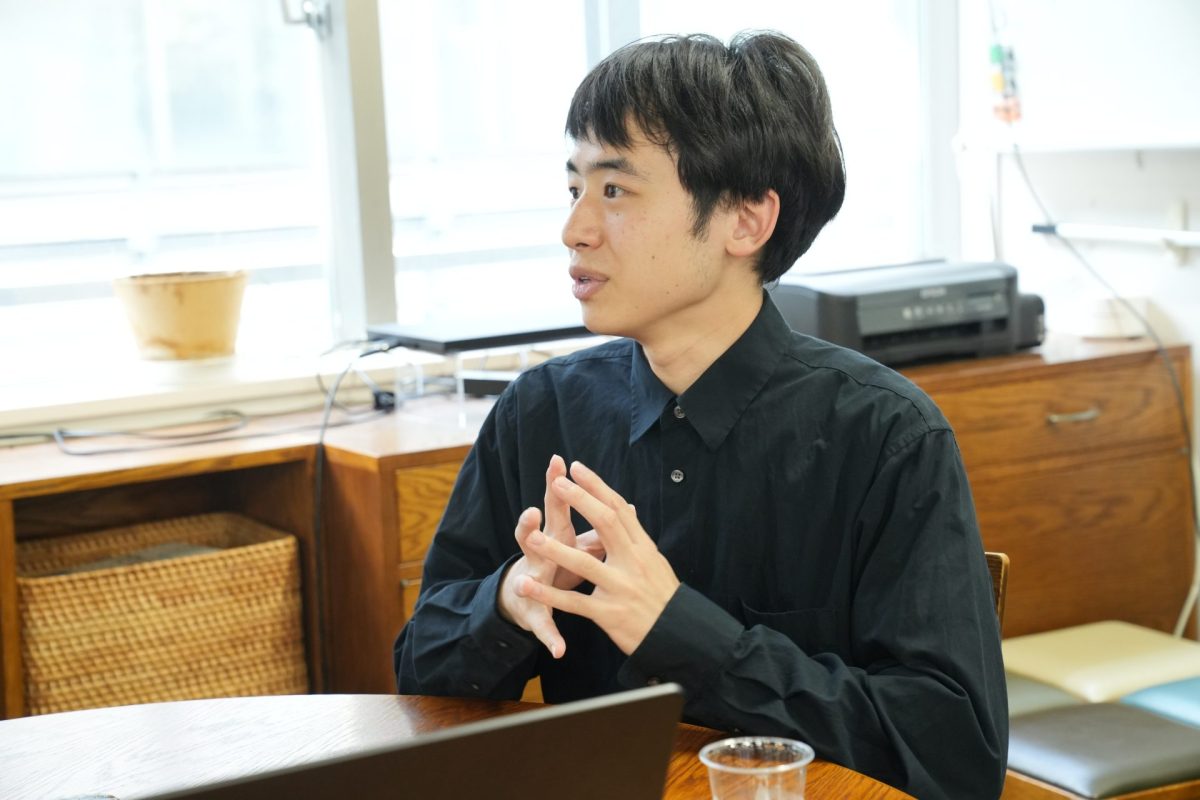
▶︎I realized that his attitude and actions involve routinely picking up problems across a wide range of areas that no one else had conceived of, not just in text communication or emotional transmission. His drive to connect these issues to research results and then contribute back to society stems directly from his real-world experiences interacting with people of different cultures, backgrounds, and values since his high school days. The symbiotic society he envisions is certainly not one driven solely by technology. Rather, it seems to be a society where technology exists to subtly support and encourage people to come closer together. Imagining the future development of his research fills me with excitement. Thank you very much for your time today.
Value Exchange Engineering PR, Kawanaka
Related Link
・Rintaro Chujo
・Mercari R4D lab Interview (Youtube)