

Focusing on “Researchers’ Big Picture,” this series explores the future societies they envision through their work. How does their research intersect with our lives? Their visions might provide valuable insight into the path ahead for all of us.
Every time I use AI,questions and speculations about the future of human interaction only grow. To discuss this, we spoke with Prof. Baba, who researches AI within the field of Value Exchange Engineering.

Interviewing:
・Name: Yukino Baba
・Affiliation: Associate Professor, Department of Multidisciplinary Sciences, Graduate School of Arts and Sciences
Encountering AI and the Path to Research
_______________________________
▶︎Why don’t we start with hobbies if I may, but you mentioned you are a fan of science fiction (SF), correct?Did the SF you encountered as a child influence your current research field?
I’ve been reading books by Shinichi Hoshi, Sakyo Komatsu, and Yasutaka Tsutsui since I was in elementary school. However, it wasn’t them who initially sparked my interest in AI but I think Evangelion was the first. I believe I was exposed to AI even before then, but Evangelion was when I clearly started becoming conscious of “AI” by name.The computer called “MAGI” in the series, which is implemented with a Personality Transplant OS, takes over the central functions of the entire city where the story is set. That aspect left a very strong impression on me as a child.
▶︎MAGI! Really? I was also excited and curious, wondering, “What exactly is an OS with transplanted personalities?” at that time. I think it was Episode 13…?
Exactly! Episode 13, “Angel Invasion” (the English title is “Lilliputian Hitcher”) is my top pick, I could probably talk about it for hours. It was around that time that I really began to look up to the scientist, Ritsuko Akagi. She’s a secondary character in Eva, but very cool and Episode 13 is dedicated to her.

▶︎That episode really drew me in because it heavily focused on the computer “MAGI”—which was supposedly just a fictional element of the story—and offered glimpses into the past and thoughts of Ritsuko Akagi.
Right, the “MAGI” system is constructed by implementing three distinct aspects of Ritsuko Akagi’s mother, Naoko, into three independent computers: “Naoko as a Mother,” “Naoko as a Woman,” and “Naoko as a Scientist.” The system is designed to reach conclusions through a sort of intense deliberation among these three AIs.That setup alone is incredibly fascinating. However, at the end of the day, it’s essentially one person—the mother—making the decision, isn’t it? I remember thinking for a long time that while the concept was amazing, maybe that wasn’t the right way to do things.
▶︎I recall there was a scene early in the story where “MAGI” came up with a success rate of 8.7%, and it was adopted immediately. How did you see that?
Whether a person views an 8.7% success rate as succeeding 87 times out of 1,000 trials, or as failing 913 times, depends heavily on human subjectivity. There are actually studies on cognitive bias showing that simply reframing 8.7% as “87 out of 1,000 times” changes people’s perception of that number.
Furthermore, within those 87 successes, there might be some extremely good results, and among the 913 failures, some might be considered failures but not catastrophic losses.
Therefore, I believe this suggests that it is not necessarily beneficial to accept numbers purely quantitatively, as they are presented.
▶︎Since many potential “maybes” or valuable cases might be hidden among numerous examples, it is necessary to evaluate everything objectively and find the value that deserves attention, in order to proceed without bias. Realizing how difficult this is for humans alone, I decided to ask further.
Ideal form of AI that she envision
_______________________________
▶︎If the results are produced by a trustworthy AI, it is easier for people to just adopt them without question, regardless of what those results are, isn’t it? What do you think about simply leaving the decision up to the AI?
When I was a postdoctor, I once asked one professor researching AI “What if we entrusted politics to AI?” His answer was “No.” The reason was that the goal of politics isn’t just the result; the process of consensus-building among stakeholders is what truly matters.That point really resonated with me, although it took me a while to fully digest it.
As a researcher, I am very curious to see what would happen if a truly human-like AI integrated into society. That being said, there have been instances where people fall in love with an AI after continuing conversations with it. We also know that even though AI is not omnipotent, some people find it easier to trust and accept information unquestioningly from an AI, especially when compared to receiving the same information from a human.
Given these tendencies, I feel a dilemma when considering society as a whole, specifically regarding the rapid advancement of AI without a shared consensus (agreement) being fully established. Whether that will truly lead humanity toward happiness is… well, I can’t really say.
▶︎Is AI trusted more easily because human interactions are prone to biases such as personal preferences and emotional factors?
Yes, that aspect does exist. There is a tendency to trust AI because it (is assumed that it) makes decisions logically based on data.Think of it as the same feeling you get when you are more inclined to trust something a doctor says. It is similar to how the same statement can be received differently depending on whether the speaker is wearing a white coat or not, or whether the speaker is an older man or a younger woman. Of course, some people might react the opposite way.
▶︎In the future, we will certainly have more complete data and AI accuracy will continue to improve. Even so, do you think it’s still better not to simply rely on AI?
Global consensus on AI development has not yet been reached, but even if it were, and even if AI were to significantly advance, I personally believe that collective decisions should always be made through human discussion. However, reaching a decision through diverse opinions and discussions—without being swayed by a few powerful voices—is extremely difficult.
To speak personally, I am actually very bad at speaking up in meetings. I feel a strong resistance to taking up others’ time with my comments, and sometimes I feel like “Does it change something even if I say it…?” Because of this, I often find it difficult to voice my opinions.
▶︎I’m not too good at meetings either. When I think about it, besides meetings, there are many situations in daily life where it’s hard to speak up when you’re faced with a lot of differing opinions, aren’t there?
There’s a really dirty garbage collection area in front of my house, and I’ve been thinking if we can clean it up somehow. But I don’t know who to talk about this problem, and even if I proposed it in an occasion such as a neighborhood association, I feel like I’d lose the argument. For instance, if someone told me, “It’s a convenient location for everyone, so please put up with it,” I wouldn’t be able to say anything back.
▶︎That’s true, the discussion tends to be swayed by a few dominant opinions.
Yes. I believe there are many other reasons why people find it difficult to express their opinions. If a situation arises where people have ideas but don’t know when or where to convey them, good ideas and valuable input will struggle to surface and remain buried.If that situation persists, unnecessary considerations and strange biases—like, “This must be treated seriously because it came from an important person”—will easily creep in, making flat, impartial opinion exchange impossible. That would be a great pity.
Therefore, I believe that if we establish a venue where everyone can properly contribute their opinions, and AI puts those submitted opinions onto the discussion table, we could have active and constructive communication. However, because I am afraid of relying too heavily on AI, I envision a mechanism where the final decision-making is still done by humans.The AI is strictly a kuroko (a stagehand, a supporting facilitator) that assists people. I think that is where the role of AI lies.

▶︎At this point, I realized that the development of “Illumidea”, which Prof. Baba is currently working on, must be based on her own experiences. So, I decided to ask her about “Illumidea”.
What is “Illumidea”, the system supports communication spaces where everyone can easily voice their opinions?
_______________________________
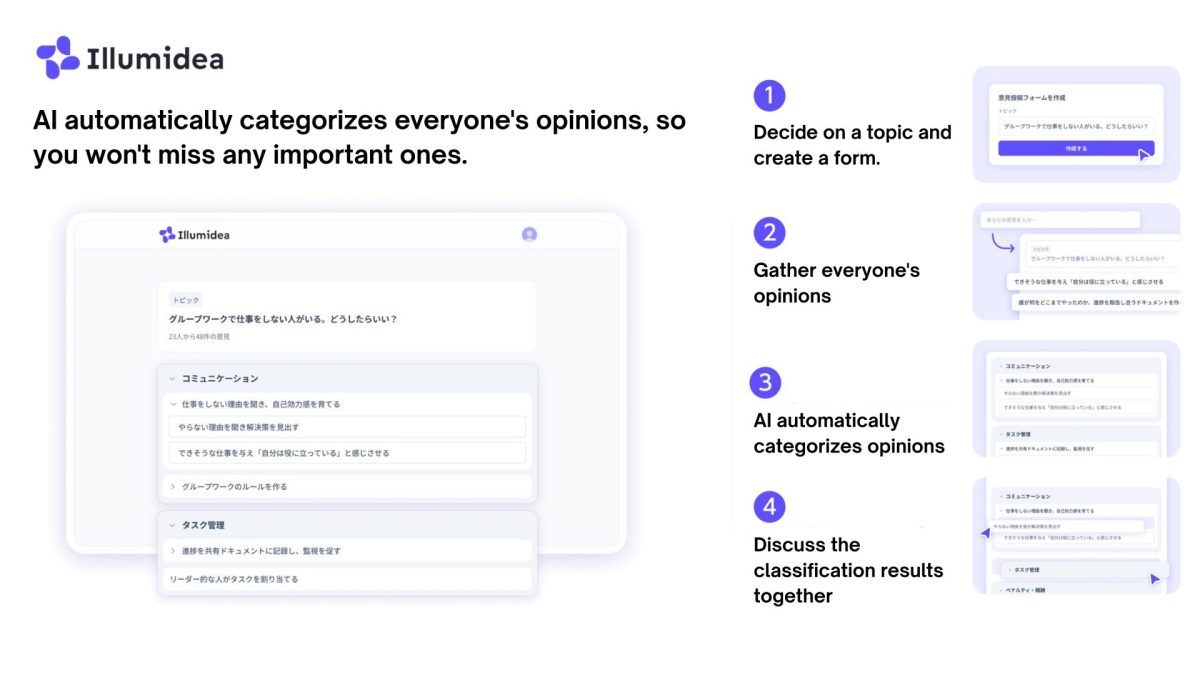
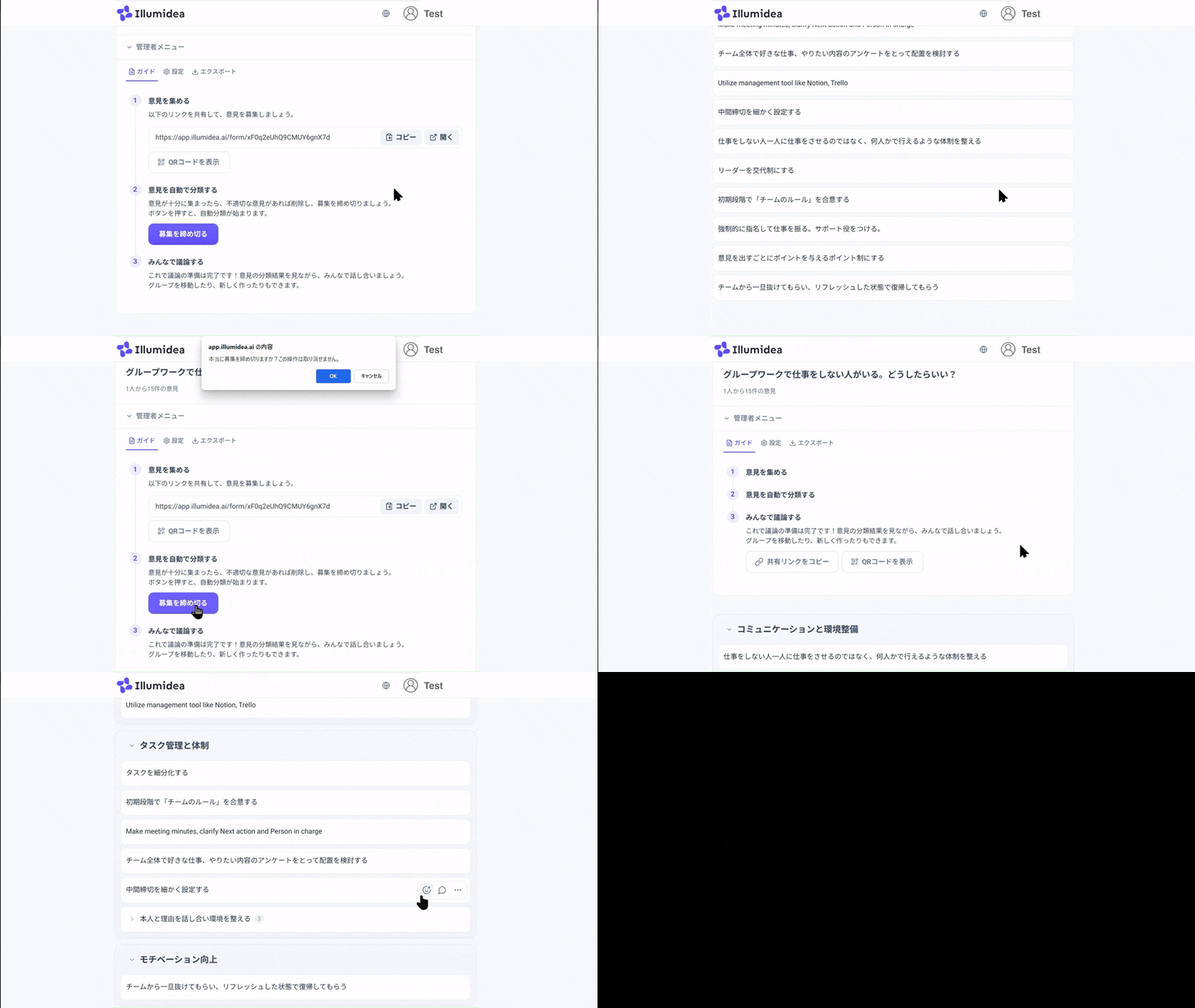
▶︎“Illumidea” is the realization of your own experience of wishing people could share their opinions more easily. When I first heard the name, I wondered what kind of service it was, but when I see the spelling, I understood it meant to spot the light on, illuminate ideas.
Although it is still in public beta, we are highly particular about making it easy for a wide range of people to use. It is fully operable on smartphones, and great care has been taken with its usability. However, I often hear that when younger employees propose, “This is good, let’s use it,” the response is often, “Why don’t we just stick to our usual meetings.” Those in higher positions sometimes fail to realize that without using such a tool, hidden opinions cannot be retrieved, making the literacy required for its adoption a challenge.
▶︎Should we consider it to be a digital suggestion box equipped with features to categorize and structure the submitted input?
Since opinions can be submitted anonymously, I believe that if Illumidea is used in familiar settings—such as neighborhood or residents’ association meetings, or in the operation of small communities like clubs—it can facilitate active communication. However, we deliberately limit the input to 120 characters per submission. Because long sentences cannot be written, the current version is probably not suitable for large public venues like government public comment processes right now. Calling it a “suggestion box” might be slightly misleading, as a result.
▶︎Why did you set a character limit?
Improving the accuracy of AI classification is one reason, but the main reason stems from my desire that users make an effort to convey their thoughts concisely and accurately if they want their opinions heard—rather than just leaving everything to the AI. When opinions are displayed, a long comment tends to draw focus. That is contrary to the direction I am aiming for.
▶︎Since opinions can be collected concisely beforehand, it allows us to organize the flow of the meeting and leads directly to a reduction in the meeting time itself.
That’s right. Since Illumidea also plays the role of a facilitator’s support, I believe it can lead to constructive time reduction. It eases the burden on experienced facilitators who are very skilled at running discussions, and I also believe it serves as a kind of sub-facilitator for those who struggle with the facilitation.
The truth is, I really want more people to realize that without using tools like this, hidden opinions cannot be gathered, and it becomes difficult to maintain a flat, impartial exchange of views.
▶︎Conversely, if it becomes easier to submit opinions and the number of inputs increases, I think more of those opinions will inevitably not be taken up due to the AI’s classification. Since people submit their opinions wanting them to be heard, wouldn’t they eventually stop submitting if their input continues to be ignored? What are your thoughts on that point?
That is a critical challenge, and as someone submitting an opinion, I believe it’s essential to know whether their input was at least raised for discussion, or if it was truly heard, even if it wasn’t adopted.
▶︎The hurdle for people to submit their opinions or not rises and falls constantly.
That’s right. So, we recently added a comment function that allows the originator of an opinion to view a record showing “This opinion was considered in this manner.” This feature, we believe, increases the satisfaction of the person submitting the input. Furthermore, we added a reaction “Likes” feature. By contributing an opinion, it would be discussed or noticed by others.
Since I really want to create a positive feedback loop, even a small one, I want people to have a good experience using it. Illumidea is fundamentally a platform for reflecting everyone’s opinions, so if we can convey, “Your opinion was reflected in this way,” I believe users will be encouraged to submit more input.
▶︎Accumulation of these positive experiences might lead to a change in people’s behavior. I asked what Illumidea is truly designed to bring about.
Value of the technology that take up all and diverse opinions
_______________________________
▶︎If “Illumidea” becomes widespread, it might serve as a catalyst for personal change, such as prompting people who were previously passive to become active.
That’s right. Since Illumidea separates the speaker from the opinion, focusing solely on the input itself without regard to “whose opinion” it is, I hope that if it becomes widely adopted, people might become more proactive in discussions even when they are not using Illumidea.
The resulting positive effects could lead to slight changes in daily behavior, such as becoming more observant of small details in everyday life. It would be wonderful if we could achieve that.
▶︎In the view of the Value Exchange Engineering project, is the ability to separate the speaker from the opinion the most crucial point connecting “Illumidea” to value exchange?
Yes. In the world, it is often the case that valuable opinions never surface due to the difficulty of speaking up, or that they are lightly dismissed because they didn’t come from a key person.The ability to separate the speaker from the opinion is the point that connects to value exchange, as it allows us to focus on the inherent value of the opinion itself.
▶︎Mercari, with whom you are conducting collaborative research, has a mission: “To circulate all forms of value and expand everyone’s potential.” I feel that this resonates with Illumidea but what are your thoughts on this connection?
Friction is inevitable in any space where people interact, but the diverse opinions and ideas put forth in those spaces are, I believe, actually because everyone is facing the same direction, striving to make things better. If there are more opportunities for smooth consensus-building, society could evolve into one where diverse individuals live and work comfortably and maximize their personal value. And I believe “Illumidea” can contribute to that.
▶︎Perhaps her underlying belief that “people, not technology, create the future” stems from having witnessed countless depictions of the future shaped by various interpretations in science fiction works. I feel that Illumidea’s approach—which finds value in expressed ideas and thoughts—has extremely high affinity with diverse fields such as education and welfare. If Illumidea’s philosophy becomes widely adopted in society, the contrasting structure of the so-called “noisy minority” against “silent majority” might disappear. I sense that a barrier-free, diverse society will then emerge, where opinions are expressed and every voice is equally respected.
Thank you very much for your insightful discussion today. I look forward to the day when the future envisioned by Illumidea becomes a reality.
Value Exchange Engineering PR, Kawanaka
Related Link
・Yukino Baba
・Illumidia official website : https://illumidea.ai/en (Currently available for free as a public beta)
・What You Can Do with Illumidea(incl. How to use)
・Baba Lab website