
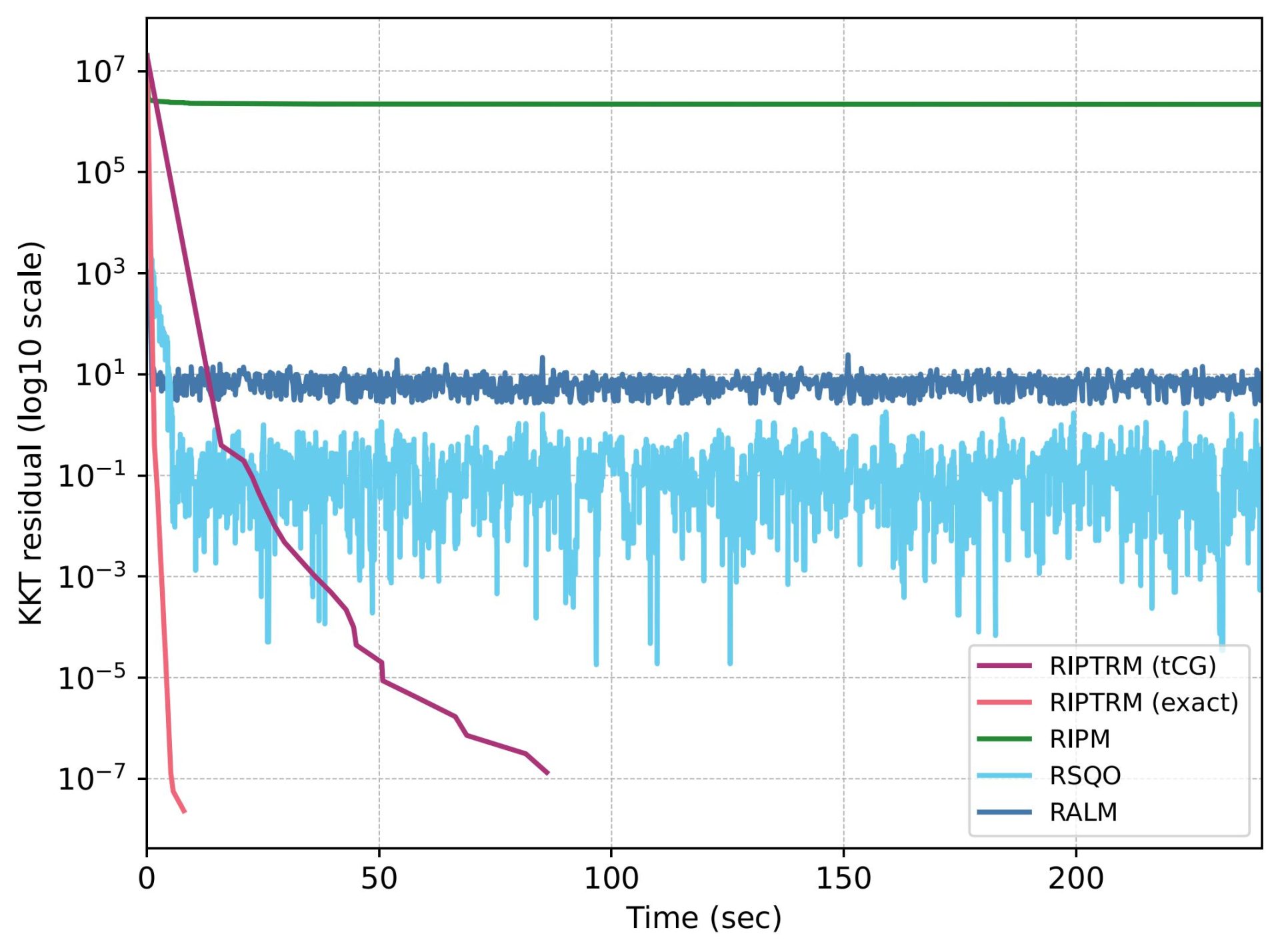
Research Key word: #Optimization #Algorithm #Modeling #Decision-making #Control 1. Overview of the research I research Mathematical Optimization Theory for better achieving objectives while satisfying given constraints. Specifically, I focus on the mathematical modeling of real-world problems and the development of algorithms to efficiently solve these problems using computers. 2. The problem addressed: I am developing algorithms for Geometric Optimization Problems. This is an abstract problem setting, which encompasses many applications, yet constructing practical solution methods for it has been challenging. 3. Research motivation and background: Geometric optimization problems appear in a wide range of fields, including control theory, data science, and robotics. Leveraging the structure of the subject matter to model it effectively is a crucial approach for addressing complex challenges and enabling high-precision solutions. 4. Results obtained: I proposed a Primal-Dual Trust Region Interior Point Method for constrained optimization problems on Riemannian manifolds. I showed that it possesses theoretical properties superior to conventional methods and that it can achieve fast and highly accurate solutions through numerical experiments. Furthermore, I applied the previously developed methods to stable system identification in control theory, proposing a method for system estimation that is more grounded in reality. 5. Relationship with value exchange (analysis/creation) and the potential impact of that research on society: Mathematical analysis and rational intervention are indispensable for realizing diverse forms of value exchange. Mathematical Optimization Theory serves as a fundamental technology supporting these activities, contributing to the creation of new value in a wide variety of applications. (Reference Link) https://arxiv.org/abs/2501.15419 https://epubs.siam.org/doi/10.1137/20M1370173
研究キーワード:#数理最適化理論 #アルゴリズム #モデリング #意思決定 #制御 1. 研究の概要 与えられた条件を満たしつつ目的をより良く達成するための「数理最適化理論」を研究しています.特に,現実の課題の数理的なモデル化と,問題を計算機で効率的に解くアルゴリズムの開発に取り組んでいます. 2. 取り組んだ問題 幾何学的な最適化問題に対するアルゴリズムを開発しています.これは抽象的な問題設定であるため多くの応用例を含む一方,実用的な解法の構築が課題となっていました. 3. 研究のモチベーションと背景 幾何学的な最適化問題は制御やデータサイエンス,ロボット工学など幅広い分野に登場します.対象の構造を活かして上手にモデル化し,複雑な課題への対応や高精度な求解を可能にするための重要なアプローチとなります. 4. 得られた結果 リーマン多様体上の制約付き最適化問題に対し,主双対信頼領域内点法を提案しました.従来手法を上回る理論的性質と,数値実験を通じて高速高精度な求解ができることを示しました.また,これまでに開発した手法を制御の安定システム同定へ応用し,より現実に即してシステムを推定する手法を提案しました. 5. 価値交換(分析/生成)との関わりと、その研究が社会に与えうるインパクト 多様な価値交換の実現には,数理に基づく分析と合理的な介入が不可欠です.数理最適化理論はそれらを支える基盤技術として,多彩な応用での新たな価値創出に貢献します.
PUBLICATIONS
- 小原光暁・奥野貴之・武田朗子・佐藤一宏, Riemannian sequential quadratic optimization method and its application to linear system identification, 京都大学数理解析研究所 共同研究(公開型)「数理最適化の理論と応用の深化」, 京都, 2021/08
- Mitsuaki Obara, Kazuhiro Sato, Hiroki Sakamoto, Takayuki Okuno and Akiko Takeda, Stable Linear System Identification with Prior Knowledge by Riemannian Sequential Quadratic Optimization, IEEE Transactions on Automatic Control, Vol. 69, Issue 3, 2023/09